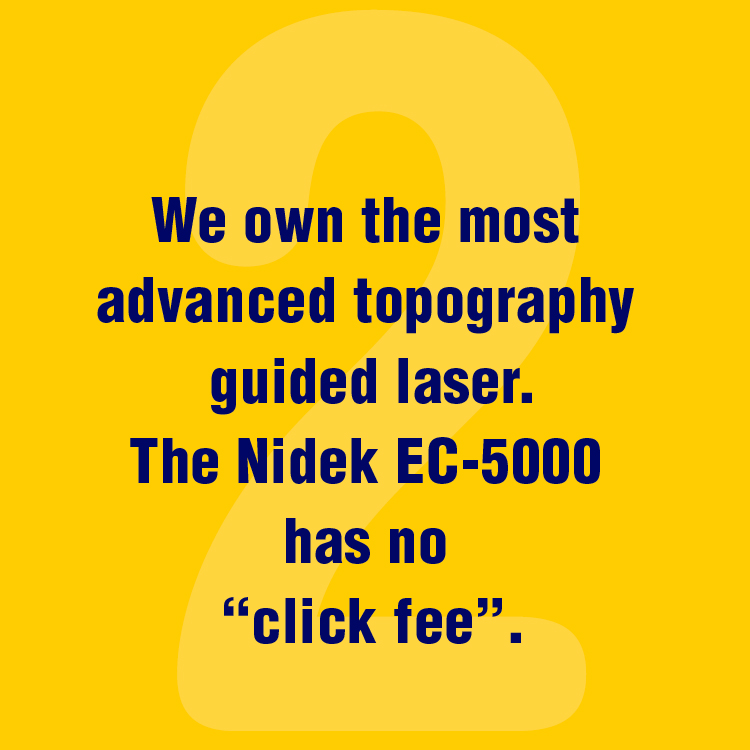
Our limited special means you pay only $2500 for the most advanced laser vison correction.
Our consultations for surgery are free.
We have no extra charges or hidden costs!
Dr. James Lewis is a graduate of Princeton University and Thomas Jefferson Medical College where he won awards in Ophthalmology and Research. He served as chief resident during his third year at Duke University Eye Center where he was offered a faculty position. Instead he travelled to South Australia for subspecialty training in Corneal and Refractive Surgery. He returned in 1990 and became Director of Cornea and Anterior Segment Surgery at Hahnemann University, in Philadelphia. He also served as Corneal Consultant to the Pennsylvania College of Optometry.
Dr. Lewis published the landmark article on Intraocular Lens Insertion without capsular support and has lectured and published extensively on this topic. He also developed instruments for suture management in corneal transplantation.
In 2004 Dr. Lewis became the Director of Cornea, Cataract, and Refracive Surgery for what is now Salus University. He teaches LASIK, Corneal Surgery, and Cataract diagnosis and management to hundreds of eye doctors each year.
Dr. Lewis designated as a member of the prestigious PS250 by Ocular Surgery News.
So, we gathered together the names of surgeons we knew were educating their colleagues about the topic at Hawaiian Eye, Kiawah Eye, OSN New York and AAO; conducting research to optimize patient clinical outcomes; digging into the diagnostic technology to assist in selecting the best patient, and the best lens for that patient; looking into the unique business aspects of premium IOL surgery; and, of course, the early adopters who saw great promise in the IOL technology. .
Dr. Lewis has participated in FDA clinical trials for Avedro, AMO, Morcher, Moria, and Staar. He is the first surgeon in the Delaware Valley to implant Staar's Visian ICL (Intraocular Contact Lens) and is one of 7 surgeons in the country selected for Staar's Collamer Accommodation Study Team.
Dr. Lewis was the first LASIK surgeon to investigate the Moria SBK microkeratome. His findings led to the approval and release of this device. He lectures on microkeratome flap creation at the American Academy of Ophthalmology, America Society of Cataract and Refractive Surgeons, The World Ophthalmology Congress, and the European Society for Cataract and Refractive Surgeons.
Finally, Dr. Lewis contributes extensively to Eyetube, an Eye Doctor Only Video Sharing website for teaching surgical techniques and disease management.
In addition to helping LASIK Philadelphia patients realize their dreams of clear vision without glasses, Dr. Lewis offers Epi-LASIK in Philadelphia. This variation of LASIK is an excellent option for patients whose corneas are too thin for LASIK. For individuals who desire to reduce their dependence on glasses but do not qualify for any type of laser eye surgery, Dr. Lewis offers Visian ICLs. He has extensive experience with these intraocular contact lenses and is regarded as a foremost Visian ICL Philadelphia/ Bucks County specialist.
Skepticism About LASIK Flap Dogma
In the contest between microkeratomes and femtosecond lasers, some surgeons question whether femto flaps are really “all that.”
By René Luthe, Senior Associate Editor
Femtosecond lasers have been hailed as the new standard of care in flap creation, touted as making flaps superior to those created by microkeratomes. While it's undeniably true that the laser's precision allows for certain characteristics of flap architecture that aren't possible with a mechanical device, those benefits are being questioned in some quarters. Some recent research has fomented a bit of agnosticism about the advantages femto flaps can deliver. Here, proponents and skeptics weigh in on the evidence.
Dr. Lewis In the News
James S. Lewis, MD has teamed up with Michael A. Aronsky, MD of Kremer Laser Eye Center to provide the latest in Corneal Transplantation.
This collaboration makes Lewis and Aronsky the first surgeons in the Delaware Valley to bring the Intralase™ Femtosecond Laser Technology to corneal replacement surgery. Dr. Lewis is a well-recognized corneal surgeon and Dr. Aronsky is one of the top Intralase™ surgeons in the country. Together they have pooled their resources to provide the top subspecialty corneal care in the region. Patients requiring advanced corneal surgery including DSEK (suture-free corneal transplanation); MDALK (partial thickness corneal surgery), and the new IEK Intralase-Enabled Keratoplasty can visit any Kremer Eye Center, the Pennsylvania College of Optometry, or Dr. James Lewis in Elkins Park, PA.
Laser Keratoplasty
IEK, IntraLase™ Enabled Keratoplasty and FLAK, Femtosecond Laser Assisted Keratoplasty are both names for this major breakthrough in corneal surgery. One of the lasers used for LASIK surgery is now being applied to corneal transplantation. The precision of the laser allows the transplanted cornea to fit more perfectly and more securely in the recipient. This leads to faster visual rehabilitation, faster return to full activities, less dependence on glasses and contacts, and fewer doctor visits.
Patients with corneal scars, severe corneal infections and keratoconus often require transplantation of the entire cornea. Until now, very skilled surgeons would fashion a round corneal "button" and mate it to a matching recipient bed. With IEK the laser fashions a more complex corneal shape and the inverse of that shape in the patient. The surgeon then fits the complementary tissue together with a few sutures.
The result is more perfect tissue alignment, greater surface area for donor-recipient healing, and less dependence on surgical technique. IEK is a bladeless technique that represents the future of full thickness corneal transplantation.
James Lewis, MD is proud to work with Michael Aronsky, MD of Kremer Eye Center and to bring this option to patients of the Delaware Valley. Dr. Lewis also performs advanced partial corneal transplant surgery called DSEK and MDALK at both Wills Eye and Kremer. He is Director of Corneal Surgery at The Eye Institute of the Pennsylvania College of Optometry at Salus University. Dr. Lewis has also pioneered LASIK and Advanced Surface Ablation to reduce contact lens and dependence on glasses following traditional corneal transplantation.
The cost of LASIK should never dictate your choice of LASIK surgeon. On the other hand it is easy to assume that paying more gets you more.
You can pay $4000 - $6000 for a surgeon with less experience, less training, less skill and less advanced equipment. In fact you can pay that kind of money for a mobile excimer lasers.
Finally, one discount corporate LASIK chain, claims to charge $899 an eye but after meeting with the sales team and financial counsellors, 85% are "upsold" to $4000 LASIK.
In summary, do your home work. Assess the surgeon's experience, reputation, training, affiliations, diagnostic equipment, laser, microkeratome, and surgical techniques. Separate fact from hype. Get the best value and the best results from this exciting and l16ife changing experience.
Schedule your free, complete evaluation now. (888) 700-EYES
See LASIK Live
Comparison of Visante OCT and
Cirrus HD-OCT Imaging of the
LASIK FLAP
AAO 2010 Presentation
Dr. James Lewis
was interviewed by
The oldest management consultancy firm founded in 1886.
Eleonor Kramarz
London, UK spoke with Dr. Lewis in mid-September, 2010 about the importance of single use instrumentation for eye surgery.
Dr Lewis said, "If we can make these devices environmentally friendly they may be well received by US surgeons. Cost considerations aside, single use, disposable, pre-inspected surgical instruments have the advantages of absolute sterility, no toxic reaction from the sterilization process, and uncompromised quality". Lewis explained that sterilization of reusable instrumentation creates environmentally unfriendly toxins, allows for expensive instrument repair, and increased costs associated with staff preparation. "Post-autoclave residual material can cause serious problems for patients having LASIK or Cataract Surgery and we still do not know if our sterilization procedures entirely eliminate the possibility of Prion transmission", Lewis said.
Dr. Lewis is currently studying the use of these single use surgical instruments. The Moria OUP SBK microkeratome, his preference for LASIK surgery, is already a single use, disposable, pre-inspected, uncompromised surgical device.